3D Bolt Master®: Screw Master®
- 4.8
- Rating
- 10.00M
- Installs
- Free
- Price

 Analysis by App-foxy
I went into 3D Bolt Master™: Screw Master® expecting a simple casual puzzle and quickly found a game built around a very specific kind of satisfaction: identifying a small group of matching bolts, removing them, and watching a cluttered 3D scene become more manageable. It is not trying to be a story-heavy adventure or a fast arcade challenge. Its appeal comes from visual order, short decisions, and the pleasant feeling of making progress with your own eyes.
That first impression matters because the game’s central idea is easy to understand without a long explanation. You look at a three-dimensional arrangement, search for three screws that belong together, and make a match. The basic action is approachable enough for a quick break, but the spatial presentation gives it more texture than a flat match puzzle. I found myself switching between immediate choices and a wider scan of the whole object, which makes each level feel more hands-on than the store’s brief “3D Bolt Master” label might suggest.
It is a free casual game from Joymaster Puzzle Game Studio, suitable for Everyone and available on devices running Android 7.0 or later. The current version is 1.3.3, and the game has already passed the ten-million-install mark while holding a 4.8 average from roughly 344 thousand ratings. Those figures suggest that the format has reached a broad audience, but they do not replace the more important question: whether you enjoy slow visual sorting and repeated matching more than dramatic action.
You May Also Like

 Blood Strike: 2.5 Anniversary
Blood Strike’s Loadouts Turn Every Drop Into a Tactical Gamble
A close look at Blood Strike’s custom loadouts: how fast access to signature weapons reshapes its battle royale rhythm, rewards preparation, and narrows the gap between fights.

 Pandora - Music & Podcasts
Pandora’s Music Is Easy to Start, but Harder to Recover
Pandora’s strength is its low-effort path from a seed to a station. Its weak spot is how much confidence it asks you to place in connection, setup, and quiet recovery.

 8 Ball Pool
 Is Built on Rivalries, Rematches, and Routine
A close look at the rivalries, rematches, shared routines, and unanswered safety questions that turn a quick pool match into a persistent mobile community.

 Samsung Music
’s Quiet Strength Is Playing What You Already Own
Its reach comes less from spectacle than from dependable access to a personal library. That simplicity is both the app’s strongest retention engine and its ceiling.

 AccuWeather: Weather Radar
AccuWeather Review: A Quick, Clear Forecast for Everyday Decisions
For everyday plans, the best forecast is the one you can understand quickly. AccuWeather makes rain timing, radar, and local conditions easy to act on, with a few trade-offs.

 Hill Climb Racing
Why Hill Climb Racing Still Turns Crashes Into One More Run
A tiny car, a bumpy hill and one more upgrade: Hill Climb Racing keeps resurfacing because its simple chaos makes every near-miss feel personal.
More From Our News Desk
View All News


Why the first few levels feel immediately readable
The strongest part of the opening experience is clarity. The screws are the stars of the screen, and the three-dimensional arrangement gives the player a simple visual problem to solve: what can I match now, and what should I leave untouched? I like that the game does not need a complicated premise to justify its play. The object in front of me is enough. I can start with the most obvious trio, then use the newly opened space to understand the next decision.
That creates a useful rhythm for casual play. A level can fit into a short pause, yet it still gives me a reason to stay focused for another attempt. This is especially suitable for someone who wants a puzzle that can be played without remembering a plot, managing a team, or learning a large set of rules. If you have a few minutes while waiting for an appointment or winding down before bed, the visual matching loop is easy to pick up again.
The trade-off is that the simplicity can become repetitive if you need constant novelty. The game’s pleasure depends on the arrangement of the bolts and on how satisfying you find the process of clearing visual clutter. Players who prefer word puzzles, narrative mysteries, or quick competitive rounds may find the opening too quiet. I would not choose it for an adrenaline rush; I would choose it when I want my attention occupied without being overloaded.
Reading the game’s visual language
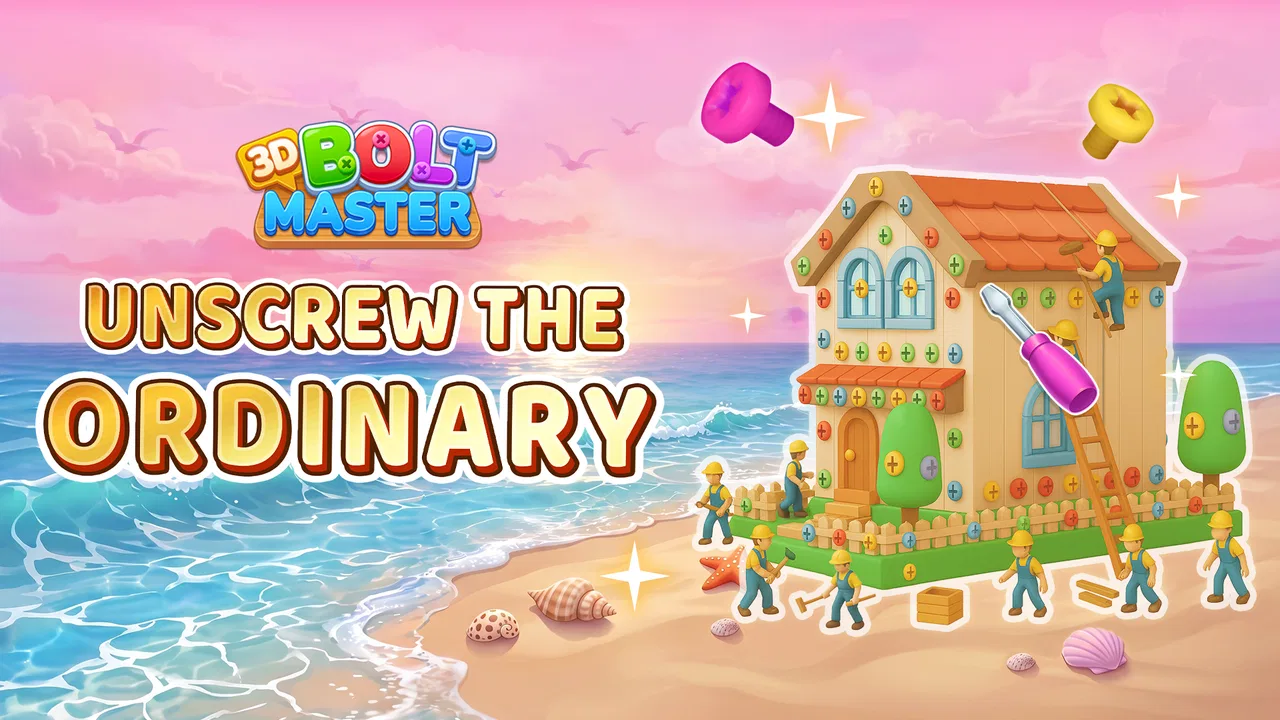
The art direction works because it keeps the object itself understandable. A screw is not just a colored tile here; it has a physical presence, with shape, depth, and position affecting how I read the board. That gives the matching mechanic a tactile mood even though I am using a touchscreen. The scene feels like something I am inspecting rather than merely a grid I am calculating.
The three-dimensional viewpoint also changes how I approach each arrangement. In a conventional flat match-three game, the board is usually visible as a stable surface. Here, I pay more attention to what is in front, what is partially hidden, and which removal might make a later match easier to recognize. That extra layer is the game’s most important identity. It makes the act of matching feel closer to sorting a small pile of objects than swapping symbols on a chart.
I found it helpful to resist the urge to tap the first available trio immediately. A better habit is to spend a moment surveying the full scene, especially when several similar screws are visible. Look for the match that improves visibility, not only the match that disappears fastest. This is a small change in approach, but it makes the three-dimensional design matter more and can prevent the board from feeling like a sequence of random taps.
The visual style also supports the game’s broad age rating. Nothing about the presentation requires specialist knowledge, and the objects are easy to recognize. That makes it a reasonable choice for families looking for a gentle puzzle, although younger players may still benefit from learning to pause before selecting a match. The game rewards observation more than reflexes, which is one reason it feels calmer than many casual alternatives.
How the setting supports a calm puzzle mood
There is no need for an elaborate fictional world to make the setting work. The implied environment is built from objects, surfaces, colors, and the act of taking things apart in an orderly way. I read the scenes as compact visual workspaces: places where the satisfaction comes from reducing confusion and exposing the next useful choice.
That setting gives the game a coherent mood. The bolts create a sense of construction and disassembly, while the clear matching goal prevents the presentation from becoming decorative for its own sake. The world language is functional, but not bland. It tells me what kind of attention the game wants: patient inspection, recognition of patterns, and a willingness to plan one or two actions ahead.
One practical consequence is that screen visibility matters more here than in a basic flat puzzle. Playing on a smaller phone can make close colors or partially obscured pieces harder to distinguish, particularly when I am holding the device at an angle. I would use a comfortable brightness level and avoid rushing through a crowded arrangement. That is not a flaw unique to this game, but the 3D presentation makes it more noticeable than in simpler tile-matching apps.
Sound, rhythm, and the feeling of each move
The game’s pacing is tied closely to the speed of my decisions. Because the core action is deliberate, the best mood comes from a steady sequence of inspection, selection, and visual clearing. I never felt that the design needed frantic tapping to stay interesting. Its rhythm is closer to a small organizing task: identify a useful group, remove it, reassess the space, and continue.
That pacing is one of the reasons I can imagine playing it in different everyday situations. During a short break, I can focus on one arrangement without committing to a long session. At home, I can slow down and treat the game as a way to settle my thoughts. The same loop can feel relaxing or mildly demanding depending on how carefully I study the scene.
Sound has an important supporting role in a game like this, even when the visual feedback does most of the work. A successful match should feel like a small confirmation rather than a dramatic event, because the game is built from many modest decisions. I prefer that kind of restrained feedback for a puzzle intended for casual use. It lets the player concentrate on the object layout instead of turning every move into spectacle.
There is also a useful pacing tip for players who become frustrated: stop treating every visible trio as equally urgent. When I slow down and make the board easier to read, the game’s rhythm becomes more controlled. I can use a safe match to open the scene, then wait before making another move. This is more effective than repeatedly tapping while hoping the next arrangement will somehow become obvious.
The limitation is that this measured rhythm will not satisfy everyone. If your favorite casual games rely on timers, chain reactions, or constant rewards, the experience may seem restrained. It does not replace a fast match-three game; it offers a different kind of engagement. The pleasure is in seeing structure emerge, not in chasing a high-speed score.
Where the mechanics and atmosphere meet
The matching rule is simple, but the 3D presentation gives it a reason to exist. Matching three screws is not merely a color-recognition exercise; it is also an exercise in deciding which visible objects deserve attention first. That connection between art direction and mechanics is the game’s clearest success. The setting communicates physical pieces, and the gameplay asks me to manipulate them mentally before I commit to a tap.
I recommend using a two-pass approach. On the first pass, I scan for obvious groups and note which pieces appear to block or surround others. On the second, I choose a match that either removes a visual obstacle or leaves the remaining pieces easier to compare. This workflow is more reliable than focusing only on the nearest objects, and it turns the game from casual tapping into a lightweight spatial puzzle.
Another useful habit is to remember the purpose of an open area. Clearing space is not automatically progress if it leaves the remaining pieces harder to read or breaks up a potential group. I try to think of each move as changing the information available to me. That is where the game has more depth than its short description suggests: the best move is often the one that improves the next decision.
At the same time, I would keep expectations realistic. This is still a casual matching game, not a complex strategy title. The decisions are accessible, and that accessibility is part of its appeal. Someone looking for a demanding logic system with many interacting rules should choose a more specialized puzzle game. Someone who wants approachable spatial sorting with a pleasant visual theme will probably get more from this one.
Free access and the practical trade-off
The game can be downloaded and played for free, with in-app purchases ranging from $0.99 to $99.99 per item. That makes the initial commitment easy: I can try the central loop without paying first. For a casual title, that is useful because the real test is personal. Some players will enjoy the tactile matching immediately, while others will discover that the repetition is not for them.
The important decision is whether the optional spending fits the way you play. I would approach purchases cautiously and first decide whether the basic progression already gives me enough enjoyment. A player who only wants occasional short sessions may have no reason to spend. Someone who plays frequently and wants convenience may view optional items differently, but the price range means it is worth checking each purchase rather than tapping through automatically.
Parents should also remember that a Everyone rating describes the content, not a household spending plan. If a child uses the device, I would enable the usual purchase safeguards before handing it over. That is a practical step for any free game with optional items, and it is especially sensible when the game is easy for a young player to understand and start playing.
The broad device support is another advantage. Android 7.0 compatibility means people using older supported phones may still be able to try it, although the experience will naturally depend on the device’s screen and performance. Since the game relies on a readable three-dimensional scene, a phone with a clearer display may feel more comfortable than an older handset with a small or dim screen.
Who will enjoy it, and who should skip it
I think this game is best for players who like visual organization, low-pressure matching, and puzzles that can be understood in seconds but still reward a little planning. It works well for a commuter who wants a self-contained distraction, a casual player who dislikes complicated controls, or anyone who finds satisfaction in clearing a messy arrangement piece by piece.
It may also suit people who normally avoid traditional match-three games because they dislike swapping tiles on a flat board. The three-dimensional bolt layout gives the familiar matching idea a different texture. You are still looking for groups of three, but the physical arrangement makes scanning and clearing feel more central than simple color alignment.
I would skip it if you want a strong narrative, competitive multiplayer, deep character progression, or action that depends on fast reactions. It is also not the right pick if repeated visual sorting feels like work rather than relaxation. In that case, a word game may offer more mental variety, while a conventional match-three title may provide more immediate chain reactions and faster feedback.
For a realistic everyday example, imagine having ten minutes before leaving for work. You can open the game, inspect a scene, make a few deliberate matches, and stop without needing to remember a storyline. Later, you can return to the same style of thinking: scan, choose a useful trio, clear space, and reassess. That makes it more flexible than games that demand a long uninterrupted session, even if it is less exciting.
My final view of the atmosphere
After spending time with it, I see 3D Bolt Master™: Screw Master® as a focused casual puzzle whose identity comes from the relationship between its look and its rules. The bolts are not just a theme placed on top of a generic board. Their depth and arrangement shape how I inspect the level, while the act of matching gradually turns a crowded scene into something orderly.
The art direction creates a tactile, workshop-like mood without needing a complicated story. The pacing stays gentle enough for short breaks, and the mechanics give that calm atmosphere a purpose. I especially like the way a good move can improve visibility, not merely remove a piece. That small strategic layer is what keeps the game from feeling completely automatic.
There are clear boundaries. The repeated matching loop will not appeal to players who need constant mechanical change, and the free-to-play structure deserves sensible purchase habits. The three-dimensional view can also demand more visual attention than a flat alternative, particularly on a small screen. Those are meaningful trade-offs, not reasons to dismiss the game.
Overall, I would recommend it to a friend who wants a free, approachable puzzle with a calm visual identity and enough spatial thinking to make each arrangement feel personal. Joymaster Puzzle Game Studio has kept the idea accessible while giving it a recognizable mood. With its Everyone rating, broad Android support, and large existing audience, it is easy to try; the real question is whether the quiet satisfaction of matching and unscrewing fits the way you like to play.
FAQs for 3D Bolt Master®: Screw Master®
01What is the main objective of 3D Bolt Master™: Screw Master®?
The main objective of 3D Bolt Master™: Screw Master® is to provide a fun and engaging experience where players can test their skills in assembling and disassembling various mechanical objects. Players use a variety of bolts and screws to complete each level, enhancing their problem-solving abilities and hand-eye coordination.
02Is 3D Bolt Master™: Screw Master® suitable for all age groups?
Yes, 3D Bolt Master™: Screw Master® is designed to be suitable for all age groups. Its intuitive interface and gradual difficulty levels make it accessible for younger players, while the challenging puzzles provide enough complexity to captivate adults, making it a family-friendly game.
03Does the game require an internet connection to play?
3D Bolt Master™: Screw Master® can be played offline, making it perfect for on-the-go gaming without requiring a constant internet connection. However, an internet connection is beneficial for downloading updates, accessing additional content, and participating in online leaderboards.
04Are there in-app purchases available in 3D Bolt Master™: Screw Master®?
Yes, there are in-app purchases available. Players can buy additional tools, skins, or hint packs to enhance their gaming experience. While these purchases can add extra fun, they are entirely optional, and the game can be fully enjoyed without spending money.
05What kind of devices are compatible with 3D Bolt Master™: Screw Master®?
3D Bolt Master™: Screw Master® is available for both Android and iOS devices. It supports a wide range of smartphones and tablets, but to ensure optimal performance, it is recommended to use a device with at least 2GB of RAM and a recent version of the operating system.
Pros
- Engaging 3D graphics enhance gameplay.
- Intuitive controls for easy navigation.
- Wide variety of levels keeps interest.
- Frequent updates with new content.
- Offline play available for convenience.
Cons
- Contains ads that interrupt gameplay.
- Limited customization options.
- In-app purchases can be pricey.
- Some levels feel repetitive.
- Occasional lag on older devices.

3D Bolt Master®: Screw Master®
Gallery